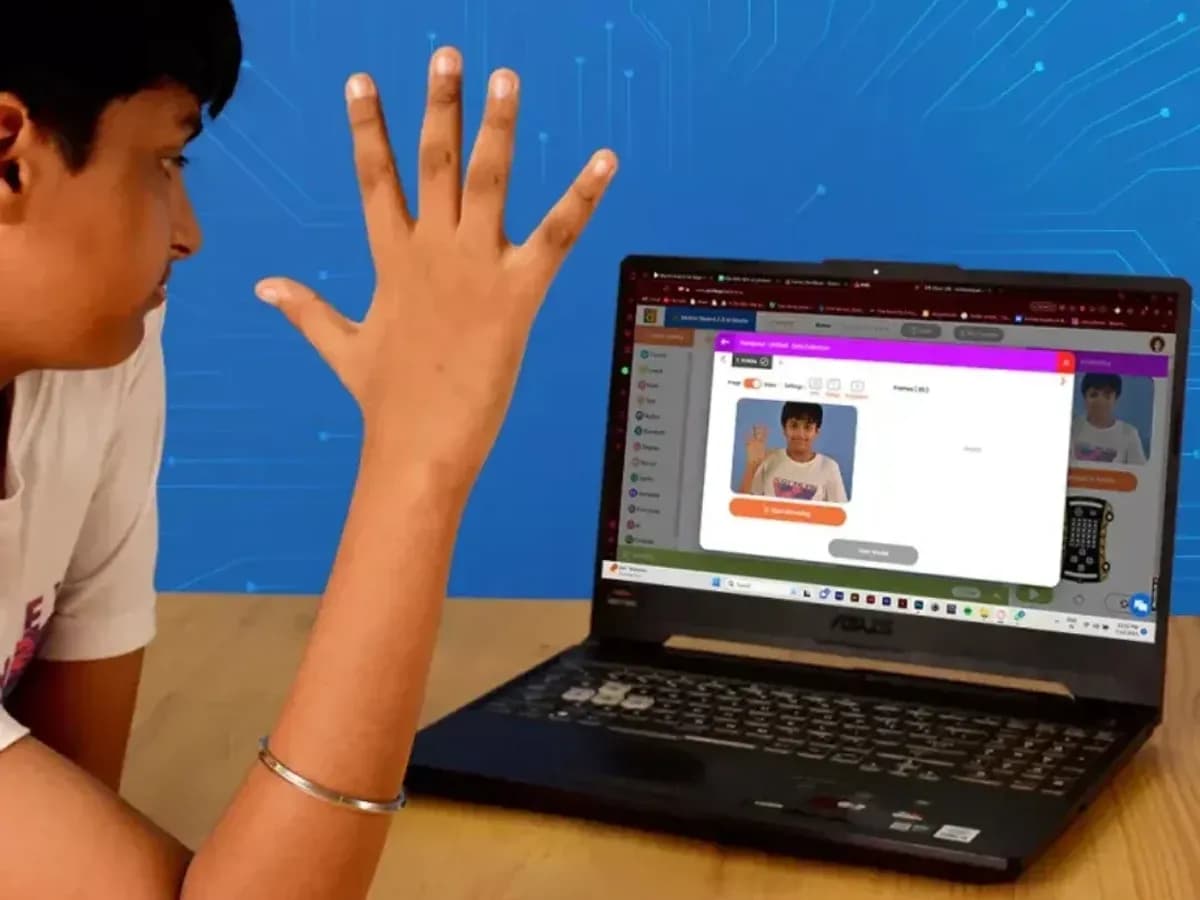
Most kids play games. Here, they make them — and the very first one is played by waving your hands at the camera.
Level 1 · Wave-to-Play Games (ages 7–10): your body is the controller. Kids build games that watch their hand movements using real AI vision, so they're jumping and ducking while they learn how games actually work.
Level 2 · Game Studio (ages 9–13): design whole worlds — levels, characters, power-ups, sound — and publish a link friends can play.
Level 3 · Pro Game Dev (ages 11–16): real code, bigger mechanics and multiplayer ideas, on the same kinds of tools grown-up studios use.
All of it runs online with just a laptop and webcam — no kit to ship, which keeps it simpler for you and cheaper for us both.
• Level 1 · Wave-to-Play Games (7–10) — hand-gesture games using real AI vision; how games loop, respond and score.
• Level 2 · Game Studio (9–13) — levels, characters, physics, sound, and publishing a playable link.
• Level 3 · Pro Game Dev (11–16) — scripting, bigger mechanics, multiplayer concepts.
Kids move up when their instructor sees the skills — usually a quarter or two per level.
Pick the campus and schedule that works for your family.
Just a laptop or desktop with a webcam and a browser — no kit is shipped, which also keeps fees lower than hardware-based classes.
Yes — Level 1 games are controlled by hand and arm movements via the webcam, so kids are standing, waving and moving while they learn game logic.
Kids start at the level matching their age and experience and are promoted when instructors see the skills — most complete a level in one to two quarters.